
Home · How to play mancala
How to play mancala, made simple
Five minute read · updated August 2026
Mancala is a family of sowing games more than a thousand years old, played from Ghana to the Caribbean under dozens of names. Its best known West African variant is called awale, or oware. No cards, no dice, no hidden information: both players see exactly the same board, and only calculation separates them.
Here are the full rules, in the order you actually need them for your first game.
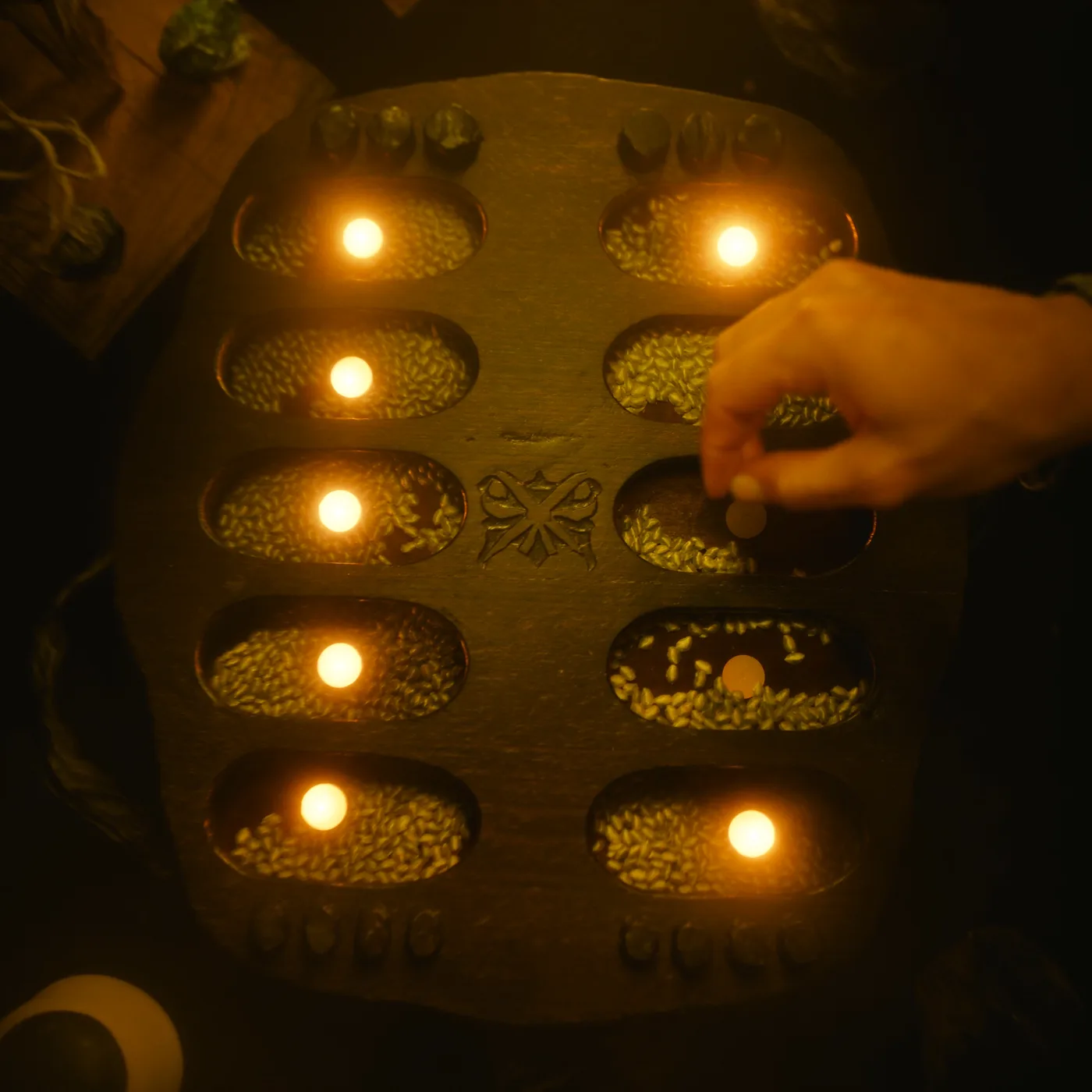
1. The board
Twelve pits in two rows of six, facing each other. The row in front of you is yours; the far row belongs to your opponent. Put four seeds in every pit, forty-eight seeds in total.
Each player also has a store beside the board, where captured seeds go. They never come back into play.
2. Sowing
On your turn, pick one pit on your side, empty it completely, and drop the seeds one at a time into the following pits, going counter-clockwise. You sow around the whole board, through your side and your opponent's alike.
Two details that settle most beginner arguments:
- you may only sow from a non-empty pit on your own side;
- if the lap is long enough to come back round, you skip the starting pit: it stays empty.
3. Capturing
This is the heart of the game, and the only rule that needs care.
And captures walk backwards: after taking, look at the previous pit. If it is also your opponent's and also holds two or three seeds, take it too, and keep going until the chain breaks.
That is where the depth comes from: an ordinary move wins two seeds, a move prepared three turns ahead can win twelve.
4. Feeding your opponent
A rule many people forget, and it decides endgames: you must always leave your opponent something to play. If they have no seeds left on their side, your move is obliged to give them some.
If no move can do that, the game stops there, and you harvest every seed left on your side.
5. Ending the game
A game ends in three ways:
- a player has captured twenty-five seeds or more: the majority is settled, they win;
- no legal move remains;
- the position loops with no capture: the remaining seeds are then shared.
Twenty-four seeds each is a draw.
The three beginner mistakes
| The mistake | What to do instead |
|---|---|
| Emptying your big pits too early | A full pit is a stock of threats. It is often worth more where it sits than played. |
| Only counting your own capture | Before sowing, count what the move leaves within your opponent's reach. Capturing three while offering eight is a bad move. |
| Forgetting to feed | Late in the game, starving your opponent does not win: it ends the game, and sometimes hands them the majority. |
Mancala, awale, oware: which name?
Mancala is the whole family, with hundreds of variants from Ethiopia to the Philippines. Awale (also oware in Ghana) is the West African variant described here: two rows of six, capture on two or three. The rules above are the ones used in tournament play.
Play right now, nothing to install
Awale Flow takes this sowing mechanic and turns it into a puzzle: objective-based levels you play alone, where every move has to be prepared. It is free, it runs in your browser, and it works offline once loaded.
Frequently asked
Are mancala and awale the same game?
Mancala names the family, awale names one variant of it. Every awale is a mancala; the reverse is not true.
How many seeds do you need to win?
Twenty-five. The board holds forty-eight, so twenty-five guarantees the majority whatever happens next.
Is mancala a game of luck?
No. No dice, no cards, no hidden information. It is pure calculation, like chess or go.
Can you play alone?
Yes, against the computer or in objective levels. That is exactly what Awale Flow offers.
← Back to home